Successful earthworm-based farming in Gaulapar gains traction across the region

O P Agnihotri/ Haldwani
A forward-looking agriculturist in the Gaulapar area of Haldwani is successfully experimenting with improving soil health and increasing crop production by using earthworm-based organic farming methods. The farmer Narendra Singh Mehra has developed a method using local resources and natural processes, which is improving field fertility, reducing the need for irrigation, and significantly increasing production.
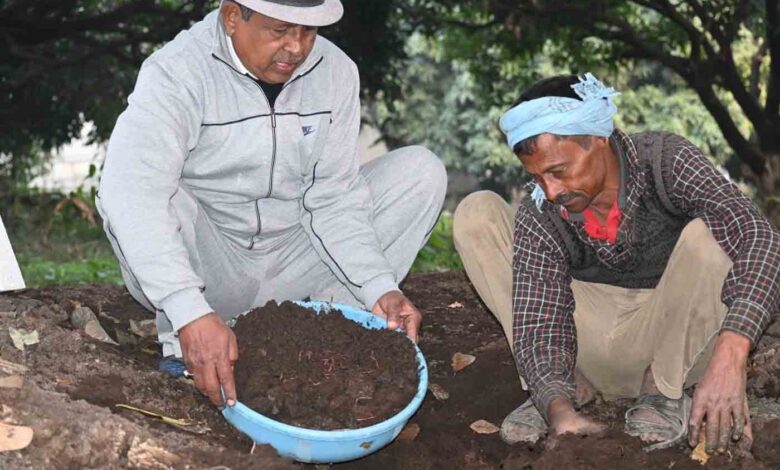
For the past one year, Mehra has been cultivating earthworms naturally by mixing organic slurry with cow dung. To do this, he collects approximately 10 quintals of cow dung in a conical shape in a shady location. He sprays Pusa Decomposer or Jeevamrit on the dung to maintain constant moisture in the pile. This process continues from the monsoon season until October, completely decomposing the dung, creating a favourable environment for earthworms.
By November or December, a large number of earthworms spontaneously emerge in this pile. They are buried about a foot deep in moist soil during the winter. Released into the field, the earthworms tunnel into the soil, eating crop residues and organic matter and naturally create vermicompost, which delivers nutrients directly to the roots.
Agricultural science says that earthworms play a vital role in improving the physical, chemical and biological structure of the soil. Their activities create microscopic pores in the soil, increasing aeration and water-holding capacity. This is why Mehra’s fields retain moisture longer and require less irrigation than before, an agriculture expert said. Furthermore, nutrients like nitrogen, phosphorus and potash available in the soil become more readily available to plants, he added.
Explaining his success, Mehra said that indiscriminate use of chemical fertilisers and pesticides has virtually eliminated earthworms from the soil, reducing the land’s natural fertility. “However, the fact is that earthworms are farmer’s friend and soil’s doctor, making the field fertile from within without any additional cost,” he noted.
The most significant advantage of this method is its low cost. While traditional vermicomposting units require crop residues, infrastructure and labour, this natural method reduces costs by approximately 90 per cent. Furthermore, the reduced irrigation also promotes water conservation.
Agricultural experts consider this a sustainable and scientifically sound initiative. They say that the return of earthworms increases soil biodiversity, accelerates the decomposition of organic matter and in the long run can reduce dependence on chemical fertilisers.
It is thus no wonder that this experiment, which began in Gaulapar, is now becoming an inspiration for farmers in the surrounding areas. This model, based on natural resources, is considered an important step towards achieving the three goals of low cost, improved production and environmental protection, agriculture experts affirm.